Stucco & plaster · Hudson Valley
Stucco and lime plaster repair in the Hudson Valley
River-town buildings carry everything from soft nineteenth-century lime plaster over brick to hard three-coat cement stucco over metal lath. Lasting repairs start by matching the mix already on the wall.
Book spring work now. Winter assessments and estimates available.
Updated November 2026

Short answer
We repair both three-coat Portland cement stucco and softer lime-based plaster across the Hudson Valley. Our crew sounds the wall for hollow pockets, fixes the flashing or crack that let water in, matches the mortar hardness so patches do not trap moisture, and blends the texture. Wet finishes need about 40 °F and rising. Text two daylight photos to start.
Key facts
- Service area
- Kingston, Rhinebeck, Red Hook, Saugerties, Woodstock, New Paltz, Hudson and Catskill, and the rest of the mid-Hudson Valley.
- Season
- EIFS and stucco finishes need about 40 °F and rising, with no freezing for 24 hours. In the Hudson Valley that means spring through late fall.
- Who does the work
- Our own crews, from The Dom Construction Group LLC.
- Insurance
- General liability, umbrella and workers' compensation insurance; certificates on request.
- Estimates
- Free. Start with 3–5 photos by text, or use the form.
- Reply
- We reply within one business day, Monday to Friday.
Cement stucco versus older lime plaster
In towns like Hudson, Catskill, Kingston, Saugerties and Rhinebeck, two buildings on the same street can look similar from the curb and wear completely different exterior mixes. Mid-century homes, garages, foundations and newer additions usually carry three-coat Portland cement stucco applied over expanded metal lath or concrete block. It cures hard, dense and strong.
Pre-war brick rowhouses, stone farmhouses and older village storefronts often carry softer lime-sand or lime-gauged plaster laid directly onto masonry or wood lath. Old masonry moves slightly through the seasons and dries outward through those open pores. When someone smears a hard Portland cement patch onto a soft lime wall, the dense patch blocks escaping vapor. Moisture collects right behind the hard crust, freezes during a January cold snap, and pops the patch off along with the face of the original plaster or brick underneath. Matching mortar strength and breathability comes before choosing a color.
Common stucco and plaster failures we repair
Tap across a suspect wall with your knuckles and you can hear where the bond has let go. Sound plaster gives a solid thud; delaminated sections ring hollow long before a chunk drops onto the walkway. Across the mid-Hudson Valley, most calls involve a few recurring problems:
- diagonal cracks stepping out from window and door corners where framing settled or head flashing was left out
- bulged, hollow-sounding panels where water rusted out the metal lath behind the scratch coat
- peeling chimney shoulders and upper flues soaked from above by cracked concrete crowns with no overhang
- foundation parging and skirt walls spalling where snowbanks, de-icing salt and roof splash-back saturate the base
- mismatched patches from earlier repairs that stand out in afternoon sun or hold dampness around their edges
How we prep, rebuild and blend the surface
Smearing hardware-store caulk along a stucco crack looks rough right away and splits open again the first winter. For tight hairline crazing on sound cement stucco, a crack-bridging elastomeric or breathable mineral coating can seal tiny surface fissures without cutting into the wall. Where plaster has separated from the backup or water got behind the lath, we saw-cut cleanly back to sound, well-keyed material.
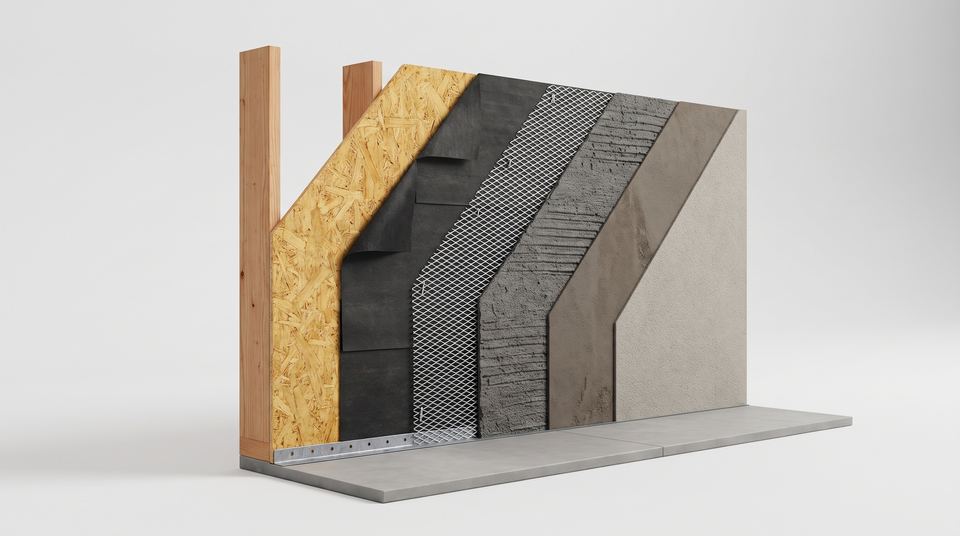
On framed walls we inspect the sheathing, repair the weather barrier, tie in corrosion-resistant lath with weep screeds or casing beads where missing, and build the patch back in cured scratch and brown coats so shrinkage stays low. On older masonry we use compatible lime-tempered mixes that move and breathe with the backup wall. Once cured, our crew floats the sand, dash or trowel texture into the surrounding field. Where old paint has chalked unevenly, we also price coating that full side corner to corner.
Typical stucco and plaster repair pricing
Localized crack repairs, small foundation parge sections or isolated hollow patches usually run from a few hundred to a couple of thousand dollars. Rebuilding large delaminated elevations, setting pipe scaffold around a tall stucco chimney, or stripping failed coatings off older masonry costs more based on wall area, access height and lath condition.
Mortar coats and finishes need temperatures around 40 °F and rising with no freezing for 24 hours, so wet work runs from spring into late fall while free estimates happen all year. For buildings combining plaster with stone or foam trim, see exterior restoration.
AI-generated illustration
Stucco and lime plaster questions
Why do hard cement patches fall off older Hudson Valley brick and plaster buildings?
Many nineteenth- and early twentieth-century buildings in river towns were plastered with soft, breathable lime-sand mixes over softer brick or rubble stone. Standard Portland cement patches are much harder, stiffer, and far less vapor-open. Moisture migrating outward stalls behind the dense cement patch, freezes in winter, and shears the patch right off along with part of the historic wall.
Do hairline cracks in cement stucco always mean the wall is failing?
Not always. Fine map-pattern crazing narrower than a business card that still sounds solid when tapped is usually minor curing shrinkage in the finish coat and can often be sealed with a crack-bridging coating. Diagonal cracks at window corners, stepped cracks, rust-stained fissures, or areas that drum hollow indicate movement or trapped moisture that requires cutting and rebuilding.
How do you repair stucco that sounds hollow when tapped but hasn't fallen off yet?
A hollow ring means the base coat has broken its mechanical bond to the metal lath or masonry backup underneath, so winter freeze-thaw will eventually drop that panel. We score around the hollow boundary with a masonry saw until we reach tightly bonded stucco, replace corroded lath and damaged building paper as needed, and rebuild scratch, brown, and finish coats.
Why do stucco chimneys peel and crack faster than house walls?
A chimney sits completely exposed above the roofline, taking wind-driven rain on all four sides plus snowmelt on top. When the concrete chimney crown cracks or stops flush with the stucco without an overhanging drip edge, water runs straight behind the plaster and freezes. Lasting chimney stucco repair pairs fresh three-coat masonry work with corrected crown and roof-step flashing details.
Can old painted stucco or plaster be recoated safely?
It depends on what sits behind the plaster. Cement stucco over wood framing with an interior vapor retarder usually accepts breathable acrylic or elastomeric coatings well once chalky paint is cleaned and primed. Older solid brick or stone buildings plastered in lime rely on drying outward, so they require high-permeability mineral or silicate coatings rather than thick film-forming paints.
Text photos of your stucco or plaster wall
Send a close-up of the crack or spall and one wide shot of the elevation.
Other wall work we handle
- Exterior restoration
Stucco, flashing, joint sealants and coatings combined in one facade scope.
- Stone veneer
Loose stones, mortar repointing and hidden leaks behind thin stone.
- EIFS repair
If the wall sounds hollow everywhere when you tap it, it is likely EIFS.
Cracked stucco or flaking plaster? Send two photos.
Book spring work now. Winter assessments and estimates available.