EIFS repair · Hudson Valley
EIFS repair across the Hudson Valley
Hollow-sounding walls with cracks, dark streaks or soft spots are usually EIFS. Most of it can be repaired in sections, as long as the leak behind it is fixed too.
Book spring work now. Winter assessments and estimates available.
Updated November 2026
Short answer
Most EIFS damage in the Hudson Valley can be repaired without re-siding the house. We open the wet or cracked area, check the sheathing, fix the flashing or sealant that let water in, rebuild the foam, mesh and base coat, and match the finish. Finish work needs about 40 °F and rising. Text a close-up and a whole-wall photo to start.
Key facts
- Service area
- Kingston, Rhinebeck, Red Hook, Saugerties, Woodstock, New Paltz, Hudson and Catskill, and the rest of the mid-Hudson Valley.
- Season
- EIFS and stucco finishes need about 40 °F and rising, with no freezing for 24 hours. In the Hudson Valley that means spring through late fall.
- Who does the work
- Our own crews, from The Dom Construction Group LLC.
- Insurance
- General liability, umbrella and workers' compensation insurance; certificates on request.
- Estimates
- Free. Start with 3–5 photos by text, or use the form.
- Reply
- We reply within one business day, Monday to Friday.
What EIFS problems do we fix?
EIFS, often called Dryvit after one brand, is foam board covered by a thin mesh-reinforced coat and a textured finish. It insulates well and it repairs well, but it is unforgiving about water. We fix:
- cracks at window corners, joints and impact points
- woodpecker and impact holes, which let water straight into the foam
- wet, soft or bulging areas, cut out and rebuilt
- failed sealant at windows, doors, vents and light fixtures
- missing kick-out and drip-cap flashing at roof lines and bands
- EIFS run into the ground or into a roof, where it wicks up water
How we decide what to open up
We look at the whole elevation first, then probe the places water usually enters: below the corners of windows, where roofs meet walls, at deck ledgers and along the bottom of the wall. Probing tells us which areas are dry and only need a surface repair, and which are wet and need to be cut out. You see photos of what we find before any price is final.
Patch, recoat or re-clad?
On a sound wall with scattered damage, we patch and blend. Where the color has faded for fifteen or twenty years, a patch will show, so we price a full recoat of that side as well. Where the sheathing is wet in many places, or an old barrier-type system keeps failing, a new drainage EIFS is usually the better money. We put the options side by side so you can choose.
What it costs
Small crack and hole repairs are often a few hundred to a couple of thousand dollars. Moisture repairs cost more, because the price follows how much of the wall has to come off and what is behind it. Good photos usually let us give you a range before we drive out.
The most common leak we find
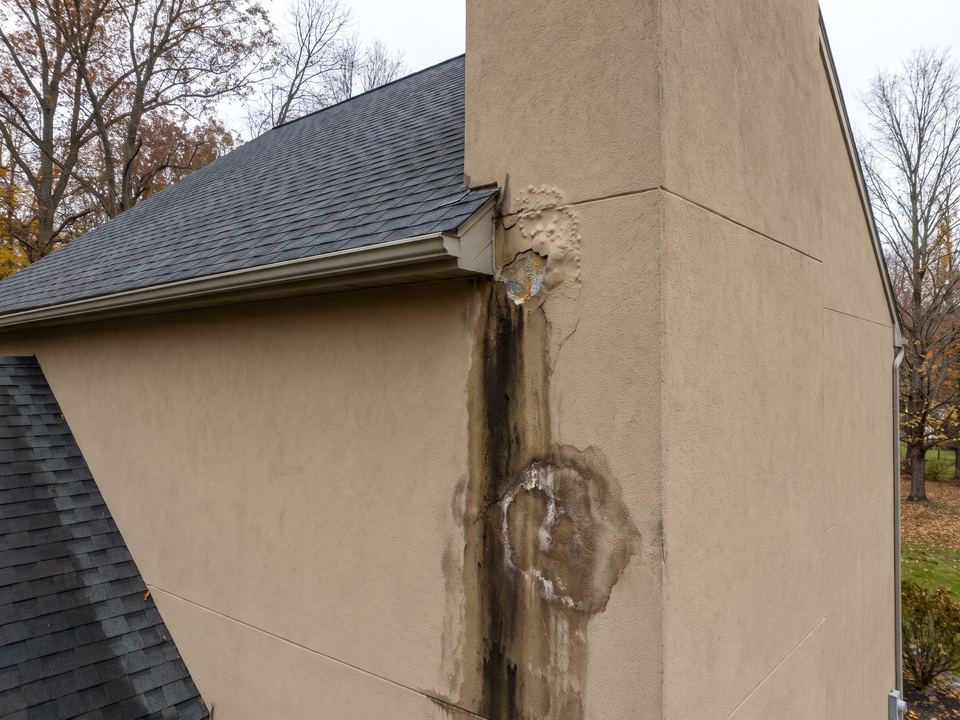
AI-generated illustration
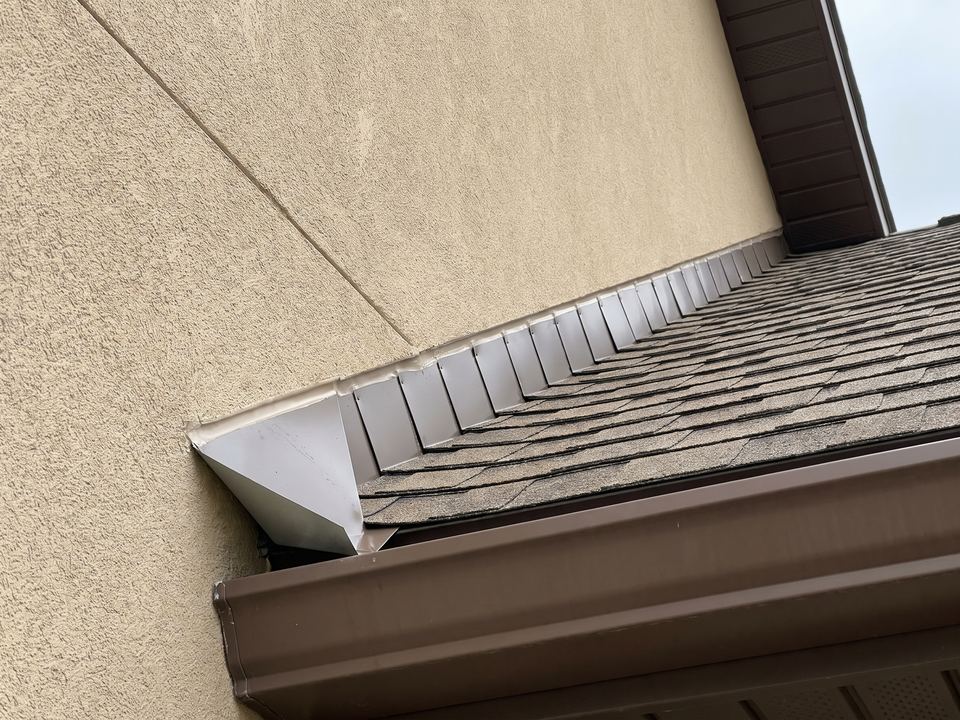
AI-generated illustration
EIFS repair questions
Why do woodpeckers drill holes in EIFS walls, and how are they repaired?
EIFS sounds hollow when pecked, which mimics dead trees where insects nest or lets birds drum to mark territory. Once the thin outer lamina is punctured, rainwater runs straight into the foam insulation. We cut the damaged ring clean, fit tight replacement EPS foam, embed overlapping fiberglass reinforcing mesh in base coat, and blend matching textured acrylic finish.
Will a patched section of EIFS match the color and texture of the rest of the wall?
We float the replacement finish to match the existing sand or aggregate texture closely, and we color-match the current wall shade. On walls that have weathered in direct sun for fifteen or twenty years, brand-new acrylic finish can still show a slight sheen difference at certain angles, so recoating that elevation corner to corner gives the most uniform appearance.
What happens if the wood or gypsum sheathing behind wet EIFS is soft?
Adhesive and mechanical fasteners cannot hold reliably onto wet, delaminating OSB, plywood, or paper-faced gypsum sheathing. Whenever moisture probing or opening a patch reveals soft substrate, we cut the cladding back until we reach dry, solid framing, install new exterior sheathing, integrate water-resistive barrier and flashing at the leak source, and then rebuild the foam and reinforced base coat.
Why shouldn't EIFS run all the way down into soil, mulch, or pavers?
When foam insulation and finish touch damp dirt, mulch beds, concrete patios, or roof shingles, the wall wicks moisture upward continuously, softens along the bottom edge, and cracks when winter frost heaves adjacent paving. Proper repair trims the bottom of the EIFS back above grade or hardscape and caps the cut edge cleanly with starter track or flashing.
Can cracked caulk around windows let enough water in to damage an EIFS wall?
Yes. Failed perimeter sealant around windows, doors, and light blocks is one of the primary ways wind-driven rain gets behind EIFS, especially at lower mitered corners. Smearing new caulk over old split silicone rarely holds; the failed joint has to be cut out cleanly, fitted with closed-cell foam backer rod, and sealed with low-modulus sealant bonded to sound base coat.
Photos of your EIFS wall for a free estimate
A close-up of the damage and one photo of the whole wall.
Related work
- New EIFS and re-cladding
When the old wall has failed in too many places to patch.
- Exterior restoration
Whole-facade repair, sealants and coatings in one scope.
- Stucco and plaster
If your wall sounds solid when you knock, it's probably stucco.
Seeing cracks or stains on EIFS? Text us a photo.
Book spring work now. Winter assessments and estimates available.